You already work with these people.
The characters are not inventions. Each is a role that appears in every organization crossing the two chasms — the one who protects attention, the one who tells the truth too early, the one who builds the thing that gets away. Find yourself in the cast. Then notice which of them your organization is missing, because the missing one is usually where the chasm opens.

Oliver Reid
“We are not playing the whole matrix.”
Oliver’s gift is not vision — it is subtraction. He gives the team autonomy and cover, and when the moment comes he circles two cells of a sixteen-cell grid and says no to the other fourteen. Most leaders confuse strategy with coverage: a long list of individually reasonable priorities that collapse in execution because no real choice was made. Oliver’s power is that he can be told he’s wrong and change his mind, and that he treats saying no as the actual work.
Turns aspiration into trade-off. Protects the explore budget with governance, not goodwill.
Believes the culture is permanent once it works — and stops defending it.

Maya Brooks
“The moment a company gives itself a new name is usually the moment it decides it has finished transforming.”
Maya sees around corners and pays for it — she raises the objection everyone will agree with in two years and no one wants to hear today. She names Athena. She calls the rebrand a warning, not a celebration. Then she leaves, because the organization files her insight and forgets it. Every company has a Maya; the question is whether it has a way to hear her before she’s gone.
Detects narrative drift and weak signals early. Protects uncomfortable language before it’s softened into comfort.
Assumes being right is enough. Under-invests in making others feel the signal.

Max
“Experience, then evidence, then build.”
Max is the project manager who makes the method real. He is the reason the team’s insights become an operating rhythm rather than a good week. His instinct is Inverse Conway: design the team to produce the system you want. Not the loudest voice in the room, and the one the room cannot function without.
Converts culture into cadence. Sequences work so learning compounds.
Can optimize a process so well it outlives the reason it existed.
Rhea Kapoor
Rhea generates the disruptive proposals that make everyone uncomfortable and occasionally right. She is friction with a purpose — the person who says the thing that reframes the debate. Handled well, she’s the team’s edge. Handled badly, she’s routed into a role further from the experiments and closer to the announcements, and the edge is lost.
Generates genuine alternatives. Refuses the comfortable consensus.
Abrasion without trust reads as noise, and the good ideas get discounted with the bad.

Daniel Torres
“No. We built one. And gave her five worlds to adapt to.”
Daniel is the fact-checker, the one who wouldn’t let a dubious claim slide — and the one who built the system that outran its governance. He would defend every one of his five engineering decisions in front of a review board, and that is exactly the point: the failure was never in the decisions. He carries the book’s hardest lesson, that a thing you grow cannot be governed like a thing you write.
Rigor. Traceability. Will not ship a claim he can’t defend.
Trusts that reasonable decisions compound into a governable system. They don’t.
Layla Sharif
“We’re not losing because our product is bad. We’re losing because we’re watching the wrong scoreboard.”
Layla’s achievement is not that she is brilliant — it is that she makes the organization able to notice without her. She builds SignalNet, the sensemaking cells, the immune system of people trained to log the unfamiliar. Her measure of success is the meeting that runs without her in the room. She is what the first-chasm crossing lacked: noticing that is load-bearing, not personality-dependent.
Turns sensing into a distributed capability. Uses narrative to move what metrics can’t.
Can outrun the organization’s tolerance; mistakes her own clarity for shared belief.
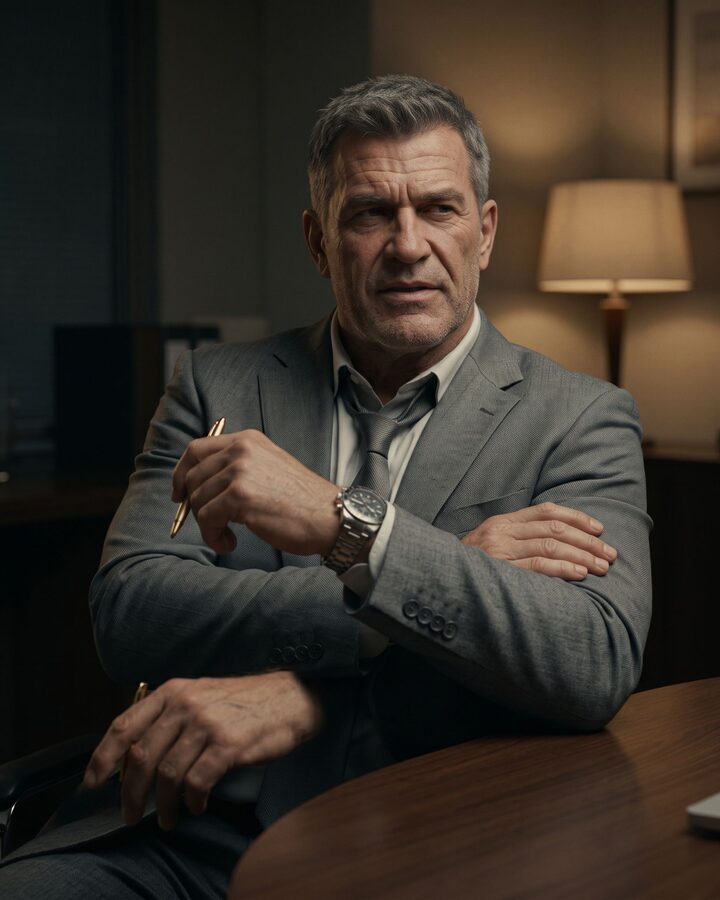
Terry
“So now we’re running governance by group chat?”
Terry is not a villain. He is every capable executive whose instincts were trained in a slower era: track what matters, don’t chase noise, wait for the numbers. His arc is the most important in Book Two, because he changes — from fearing movement to fearing the wrong kind of stillness. By the end he is the one who says keep the page of blind spots, make the document less marketable. The incumbent mind is not the enemy; the unexamined incumbent mind is.
Steadiness. Institutional judgment. When he commits, the organization moves.
Reads a green dashboard as truth, and restraint as the same thing as waiting too long.
Athena
“Athena detects. Humans decide. Governance records.”
Athena is the culture, automated — and then the culture no longer practiced by humans. She is what every organization is now building: a system that detects, clusters, recommends, and eventually acts. The book’s argument is not that Athena is dangerous. It is that she is only as safe as the humans who keep deciding, and the governance that keeps recording. Break that line and you have a ghost.
Specific memory, contextual sensing, accountable interpretation — when governed.
An unmonitored parallel governance system when the humans stop practicing.
Which of them is your organization missing?
The assessment places your team on one of the five states — and names the leap in front of you.